Global Procurement Guide: How to Choose the Most Outstanding Skin Analyzer for Your Medical Aesthetic Clinic?
In today’s world where digital medical aesthetics and scientific skincare are taking the globe by storm, a top-tier skin analyzer is no longer a “luxury” for beauty salons, but the “core productivity” for achieving high conversion and repeat purchase rates. It visualizes and data-fies sub-surface skin problems invisible to the naked eye, helping institutions establish undeniable professional trust.
However, faced with a vast array of brands on the market, overseas buyers, medical aesthetic chains, and cosmetics retailers often harbor significant concerns: Is the device’s analysis accurate? Does it comply with local regulations? Is the after-sales service system robust? Are the operating procedures overly complex?
As an experienced beauty equipment manufacturer, today we present a fully grounded, pain-point-targeted procurement guide for skin analyzers, covering core technology comparison, parameter configurations, QC inspection, after-sales maintenance, and daily operational applications.
I. Core Technology & Indicators: How to Identify the “Gold Content” of a Skin Analyzer?
The core value of a skin analyzer lies in its spectral imaging technology and the accuracy of its algorithms. Low-end devices often feature only 1–2 light sources, scraping only the skin’s surface, while professional-grade equipment can peer deep into the skin base.
1.1 Eight Spectral Imaging Technologies for Deeply Analyzing the Skin’s Foundation
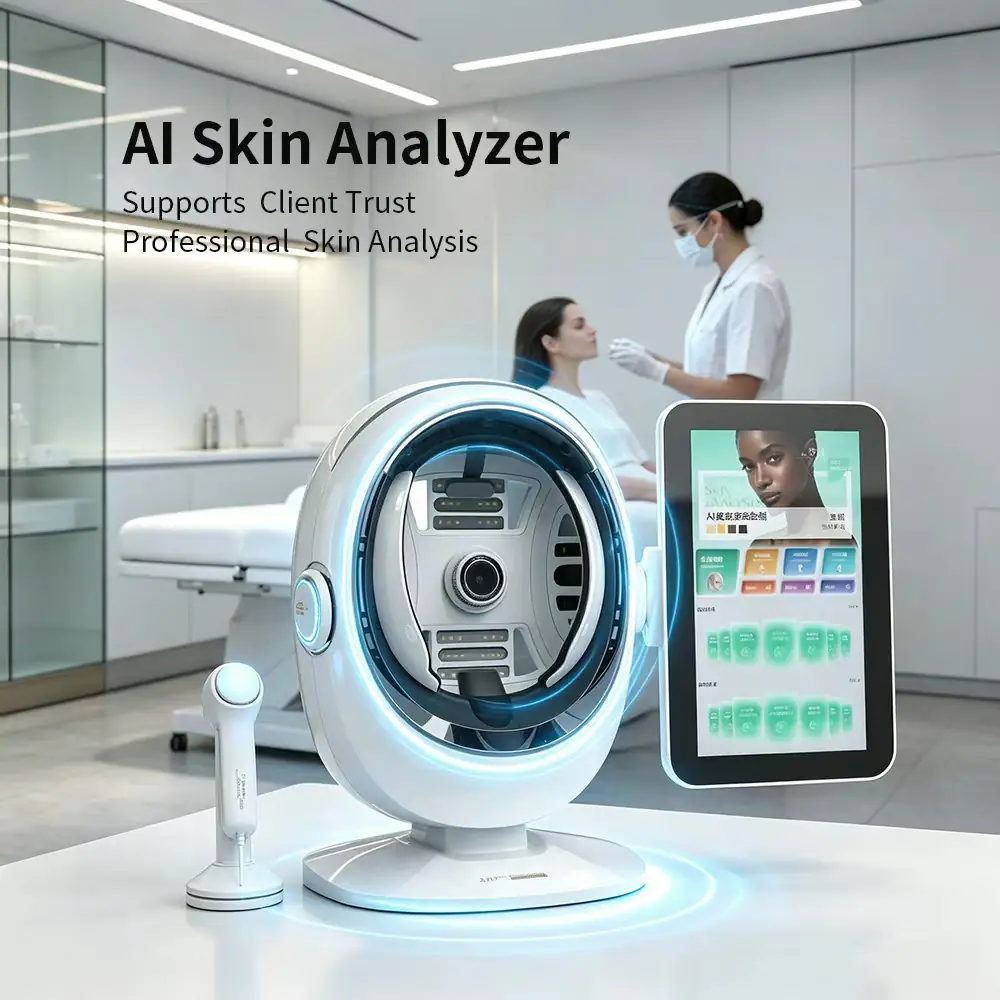
Taking the 2026 K57 AI Intelligent Skin Analyzer as an example, it integrates 8 major spectral imaging technologies, allowing a comprehensive analysis in a single capture session and covering 18 distinct skin indicators:
White Light: Simulates natural light to clearly display surface blemishes visible to the naked eye—such as spots, acne, wrinkles, and pores—serving as the benchmark baseline for all spectral comparisons.
Positive Polarized Light: Effectively improves the clarity of skin surface textures and magnifies local details, making it ideal for deep observations of skin smoothness, fine lines, collagen loss, and uneven indentations (like acne pits).
Negative Polarized Technology: Filters out surface skin reflections, allowing operators to clearly identify light brown, dark brown, and dark red skin lesions, thereby accurately distinguishing microvascular expansion, facial breakouts, and skin tone uniformity issues.
Wood’s Light: Utilizes the principle that deep-layer melanin does not fluoresce under ultraviolet radiation, making deep dermal pigmentations stand out with high contrast, dedicated to detecting deep pigment accumulation.
UV Light: Under UV illumination, the content and distribution of porphyrins (such as bilirubin) fluoresce clearly, providing a powerful auxiliary diagnostic basis for pigmentary skin diseases, clogged pores, and skin infections.
Red Light / RBX Technology: Adopts RBX optical path technology to deeply analyze subcutaneous hemoglobin and inflammatory pigments, such as sensitive skin, redness, vascular expansion, and acne inflammation.
Brown Light / RBX Technology: Pinpoints the precise location, area, shape, and severity of subcutaneous UV spots, visually reflecting ultraviolet damage and underlying melanin accumulation.
Mixed Light: Uses polarized analysis to reveal the skin’s overall roughness and collagen loss status.
1.2 3D Capturing and 270° Seamless Coverage
Traditional skin analyzers often require adjusting the client’s seating position multiple times to capture the front face, left side, and right side, which is not only inefficient but also prone to data distortion due to changes in angle and light. The K57 skin analyzer achieves simultaneous three-sided imaging of the front, left profile, and right profile in a single capture, reaching a 270° seamless coverage and boosting collection efficiency by 300%.
II. 2026 K57 Skin Analyzer Core Hardware Specifications
During procurement, hardware configuration determines the device’s operational smoothness, image clarity, and lifespan. The following outlines the industrial-grade core parameters of the skin analysis device:
Hardware Module
Core Parameter Indicator
Procurement Value & Consideration
Camera
Industrial-grade 36-megapixel (36 million pixels)
Ensures pores, skin flakes, and microvascular lines are clearly visible; sharp even when magnified.
CPU
RK3568 Quad-core Cortex-A55, max main frequency 2.0GHz
Industrial-grade architecture, extremely fast and stable when processing AI big data algorithms and 3D sliced images.
OS & Memory
Android 11 / 4G Dual-channel LP DDR4 / 32G EMMC
Zero lag when sliding through the interface; supports large-capacity local and cloud storage for files.
Display Screen
15.6-inch ultra-large touchscreen, 1920*1080 high resolution, supports 90-degree folding
Clients can visually view their analysis reports; the folding design makes packaging and transport convenient.
Connectivity
Built-in Dual-band Wi-Fi (2.4G/5G) + RJ45 standard ethernet port
Image uploading to AI cloud servers for analysis is faster and more stable.
Shading Design
Semi-open shading hood
Effectively blocks external ambient light interference while avoiding the oppressive feel of fully enclosed structures.
Shell Material
Industrial-grade high-strength ABS material
Wear-resistant, wipe-resistant (supports alcohol disinfection), and does not easily yellow or age.
Ports
HDMI *1, USB *3 (including expansion probe interface)
Convenient for external large-screen demonstrations or connecting microscopic detection probes.
III. Overcoming Trust Concerns: Product Quality and Certification
For bulk overseas procurement or the import of high-value equipment, customers are often most concerned about quality compliance and customs certification issues.
3.1 Rigorous Quality Control (QC) Testing
Every skin analyzer we manufacture must pass strict testing before leaving the factory:
Component Aging Test: Power-on aging tests are performed on the motherboard and core LED light source array to ensure the light decay rate remains well below industry standards.
Dynamic Camera Calibration: Precision multi-point focusing and color reproduction tests are conducted on the 36-megapixel lens to eliminate any color deviation.
System Stress Test: Continuous operation of the AI skin analysis algorithm ensures zero system crashes or lag.
3.2 International Certifications
As an established, large-scale manufacturer, we possess comprehensive qualifications for international export compliance. Our equipment has obtained multiple authoritative international certifications:
FDA Certification: Complies with the rigorous regulatory and market access standards of the U.S. Food and Drug Administration (FDA), ensuring the delivery of products with exceptional safety, performance, and compliance to medical and medical-aesthetic professionals worldwide.
CE and RoHS Certifications: Meets the European market’s strict standards for electrical safety and environmental protection.
ISO 9001 Quality Management System Certification: Ensures full traceability across every stage of the production process.
IV. Operation Training, Daily Maintenance, and After-Sales Warranty: Buy with Confidence, Use with Peace of Mind
4.1 Zero-Basis Hassle-Free Operation Training
No need to worry about staff not knowing how to use it! The skin analysis system embeds “Must-Read on Boot” and “Video Tutorial” sections right on the screen, allowing new employees to get started quickly just by following the video demonstrations. The boot process is extremely streamlined: connect to power → connect to dual-band Wi-Fi → scan the code via email to activate, and smart skin testing begins.
4.2 Daily Cleaning & Maintenance Advice
To maintain the precision of the camera lens and ensure equipment hygiene, please strictly adhere to the following maintenance standards:
Daily Cleaning: Use a soft semi-dry cotton ball moistened with 75% medical alcohol to wipe down the chin rest, forehead rest, and microscopic test probe. Never use organic solvents like acetone, and do not use high-temperature sterilization.
Prevent Liquid Infiltration: Do not let any liquids seep into the screen edges, connectors, or the interior of the instrument during wiping, as this can cause short circuits or rusty ports.
Moisture Probe Calibration: The system comes with its own “Moisture Calibration” tool. When using the attached handheld microscopic testing probe (with metal contact points) to collect facial moisture, if a reading failure occurs, simply click “Start Calibration” under My Device. Keeping it away from the skin during calibration easily restores high accuracy.
Long-Term Storage: If the equipment is idle for more than 6 consecutive months, place it in a dry, ventilated area (cover with a cloth to prevent dust when not in use), and make sure to turn it on for 1–2 hours every year to use the machine’s own heat to expel internal moisture.
4.3 Official Warranty Service
We provide an after-sales commitment that leaves you with no worries:
The main machine comes with a free 3-year warranty, while random accessories (microscopic test probe, power cables, etc.) enjoy a 180-day warranty period.
During the warranty period, hardware failures caused by non-human and non-force majeure factors (such as non-lightning strikes, non-abnormal grid voltage inputs, etc.) will be covered with free replacement parts.
Lifetime Technical Support: After the warranty period expires, we still provide long-term paid maintenance services, and all core components will be provided at original factory cost prices.
Conclusion: Choosing Us Means Choosing the Future of Scientific Face Consultations
An excellent skin analyzer is not just a tool for checking the skin; it is an unshakeable bridge of trust built between your medical aesthetic institution and your clients. If you are looking for a device with superb technology, overseas compliance, and perfect after-sales support, the 2026 K57 skin analyzer is definitely your premier choice.
Feel free to contact us anytime to get the latest bulk purchasing quotes and OEM/ODM customization plans!
Opening a new medical spa, upgrading an existing practice, or expanding your treatment menu is one of the most exciting milestones for any aesthetic professional....
Introduction Multifunctional aesthetic devices integrate various treatment technologies into a single unit. As system integration increases, routine maintenance becomes essential. Dust, residue, contaminated cooling water,...
Introduction Professional beauty clinics often need equipment that can handle different treatment needs without taking up too much space. This is especially important for clinics...
The medical aesthetics equipment market is growing rapidly worldwide. Laser hair removal technology has become one of the fastest-growing treatment options among cosmetic clinics, medical...
Choosing an RF microneedling machine involves more than comparing power ratings and needle counts.. Two machines may look similar on paper but offer very different treatment...
The global non-invasive body contouring market is growing rapidly. Today’s clients are no longer satisfied with simple fat reduction; they demand dual-action treatments that sculpt,...