Skin Analysis Software Data Privacy: Clinic Guide
Skin analysis software data privacy starts with knowing where images go, why they are used, who can access them, and how each copy is removed....

A fractional CO2 laser machine is a clinic-based medical device that delivers 10,600 nm light into the skin as a dense grid of small, separated points. In one pass it removes a thin layer of damaged tissue at each point and leaves the skin between them untouched. Clinics reach for it when texture or scarring has to change beyond what a chemical peel reaches.
A sealed laser tube sits in the console, direct-current or radio-frequency depending on configuration, and both types produce the same 10,600 nm output. A closed cooling circuit holds the tube at a steady temperature. The beam then travels along an articulated arm of mirrors rather than through a fibre, and at the far end a treatment head steers it across the skin with galvanometer mirrors. Interchangeable heads cover different jobs, a touch screen carries the settings, and a smoke line pulls away the plume. It takes up part of one treatment room, runs on ordinary clinic power, and needs one operator and one assistant.
A few boundaries are worth setting early. This is not a home device; the energy sits well above what a consumer unit delivers, which is why the work needs clinical supervision. Nor is it the same instrument as a fully ablative laser, which strips the whole epidermal layer in one pass instead of leaving islands of intact skin. It is not interchangeable with erbium, whose light is absorbed more strongly by water and stops shallower, or with picosecond platforms, which use acoustic rather than sustained heat.
Water is the target. Tissue holds enough of it that 10,600 nm light is absorbed within a very shallow layer at the surface, and that is what makes precise surface work possible at all. Absorption is strong enough that energy turns into heat almost exactly where it lands rather than scattering sideways, which is why this wavelength behaves so differently from near-infrared platforms.
A CO2 beam at this wavelength loses power and quality when forced through glass fibre, so the design routes it through a rigid arm instead: a sealed metal tube with a mirror at each joint. The arm uses a balanced counterweight design to keep the optics in balance. Its seven joints turn freely, letting the head reach a treatment area from different angles and distances in three dimensions without pulling or blocking the beam path, which makes the work easier to perform and far less tiring on the hands.
Because the tube is sealed, the beam has no route out of it. That matters at 10,600 nm: the energy is invisible, and at this power a stray reflection can burn skin or eye tissue with no visible warning, which is why the wall matters for the operator as much as for the patient. The same sealed tube protects the optics: a rigid, precisely aligned structure keeps the beam in its original mode and gives up very little on the way through, so every micro-spot carries the dose the settings called for. At the head, galvanometer mirrors sweep the beam across the treatment area, while a red aiming beam at 650 nm shows where the invisible energy will land. The operator sets a pattern instead of tracing each point by hand, and the scanners reproduce it exactly from one pass to the next.
Each point of the grid becomes a microscopic thermal zone: a narrow column of heated tissue running from the surface to a depth set by the energy delivered and the time over which it is delivered. Between the columns, untreated skin remains, and that untouched skin is the whole point of the design. Keratinocytes migrate from the edges of intact tissue across the treated columns while fibroblasts in the surrounding dermis stay active, so re-epithelialisation runs faster than it would across a fully denuded surface.
The weeks after matter more than the session itself. The dermis keeps remodelling, fresh collagen is laid down, and the treated columns are replaced by organised tissue rather than scar. Most visible change appears in that stage.
Five settings decide what the beam does, and each answers a different question.
That is the vocabulary. What matters is how they interact.
This is where most product comparisons go wrong. Point density is not proportional to spacing; it is inversely proportional to its square. A square area holds roughly one point per spacing squared, so pulling the distance from 2 mm to 1 mm does not double the count. It quadruples it, because the same area now takes four times as many rows and columns.
Density figures on a comparison chart look comparable across brands. For a CO2 laser machine for skin, they rarely are. A spacing of 2.6 mm and one of 0.1 mm differ by a factor of twenty-six, so density differs by that factor squared, close to seven hundred times. No stepped control expresses a range that size: it offers high, medium and low, and nothing between. A clinician who needs a figure between two presets has to compromise: a density too light to change texture, or one heavier than the skin will comfortably tolerate.
One qualification applies. Once spacing falls below the diameter of the beam spot, adjacent columns overlap and the pattern stops behaving as a grid. The tissue is then treated more like a continuous sheet and recovery shifts with it. Spacing is a strong control, but it is not unlimited.
If spacing decides how many columns there are, dwell time decides how much each one receives. Holding the beam on a point longer delivers more energy to it, and the heated column reaches deeper. The relationship does not stay linear. Past a certain point, added time spreads heat sideways into surrounding tissue rather than deeper, so the useful gain flattens while the collateral effect keeps climbing. That is why a wide dwell-time range matters more than a high maximum: the settings worth using sit in the middle, and a machine locked to one fixed pulse width forces the operator to plan around a factory value. Dwell time never works alone: at a fixed dwell, a higher wattage delivers more energy to each column.
Two sessions can use identical power, spacing and dwell time, then produce different tissue responses, because of the order in which points fire. In a strictly sequential pattern each point sits beside the one fired a moment earlier. Heat from the first has had no time to dissipate before the second adds to it; where passes overlap heavily, that heat accumulates into a band of unintended thermal load. Random ordering breaks the chain: neighbouring points fire at separated moments, so each column sheds heat before its neighbour is treated. Split ordering gets there by working through the area in sections. The pattern looks identical in all three cases. What differs is how much heat the tissue between the columns actually absorbs.
| Adjustment | Range on this machine | Why it changes the outcome | What a stepped control cannot express |
| Point spacing | 0.1 – 2.6 mm, continuous | Density rises with the square of the spacing | High, medium, low only; values between are unreachable |
| Dwell time per point | 0.1 – 10 ms | Sets how much heat each column absorbs | Depth and heat stay tied to one fixed pulse width |
| Output power | 1 – 60 W, continuous | Energy delivery rate and coverage speed | No fine step to trade against dwell time |
| Scan order | Sequential, random, split | Random order lets tissue shed heat before a neighbour fires | Sequential only, so dense passes accumulate heat |
| Scan area and shape | Up to 20 × 20 mm; eight shapes plus freehand | Lets the pattern follow the area instead of overlapping a fixed square | One fixed square or circle |
| Energy per point | Up to 80 mJ | Combines with dwell time to set dose per column | Per-point dose cannot be set apart from wattage |
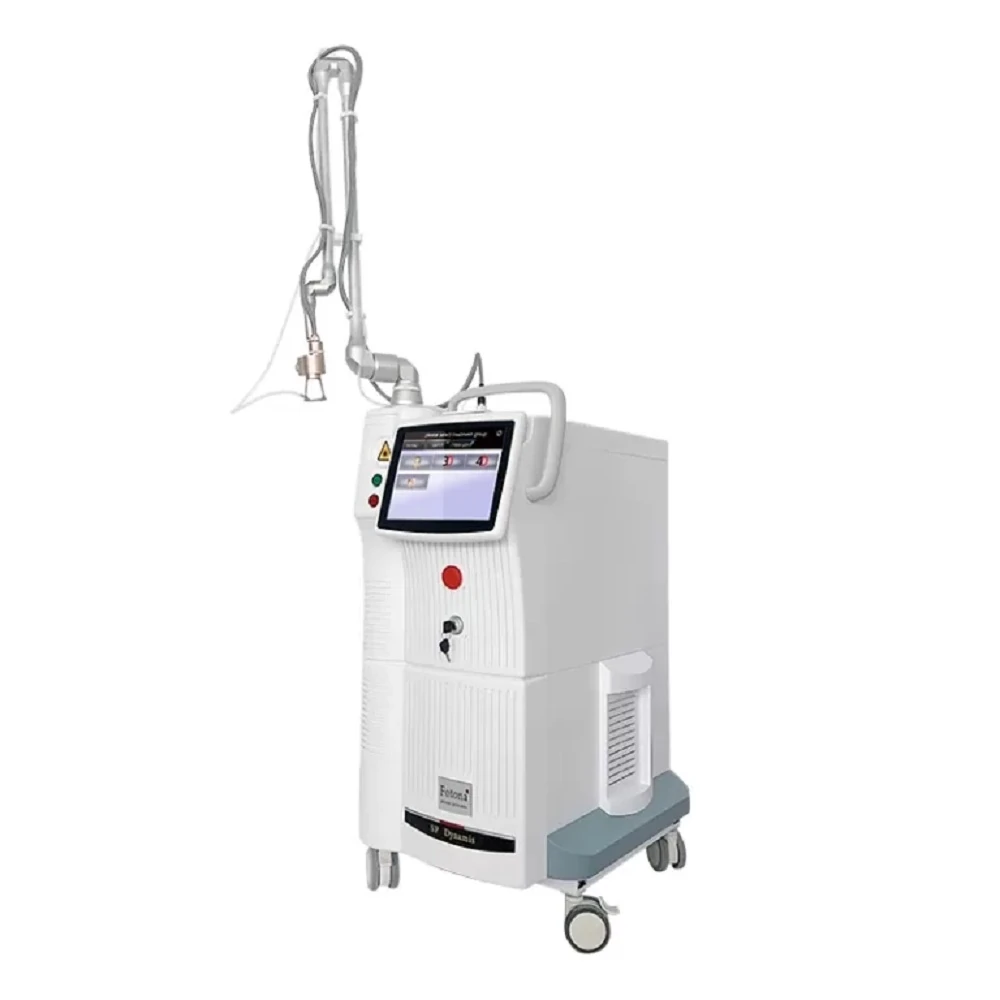
When CO2 fractional laser equipment is designed around this logic, the operator gets a continuous range instead of a menu. Output power runs from 1 W to 60 W, point spacing from 0.1 mm to 2.6 mm, and dwell time from 0.1 ms to 10 ms. Scan order, shape and area are discrete choices by design. That split is what lets a light pass on thin skin and a dense one on a scar come from one console, with no value forced between two presets. The beam itself can run continuous, single-pulse, interval-pulse or super-pulse.
The pattern matters as much as the numbers. This head offers eight fixed shapes — rectangular, elliptical, circular, triangular, hexagonal, linear, square and diamond — plus a freehand mode for areas that fit none of them. That range earns its place in practice, where a treatment zone rarely matches a rectangle: a linear pass along a scar and an elliptical field across a cheek call for different coverage, and tracing by hand follows the real border instead of a stock shape.
The same head mixes two patterns within one pass. In the 5D and 6D modes a spiral component combines with the fractional grid, so one pass covers a superficial and a deeper layer at once. The wider spiral is what holds treated volume in check while still reaching tissue a single-level pattern would miss.
Mode selection is where this machine parts company with a single-purpose unit. Three modes are available: fractional for skin, a standard pulsed mode for conventional work, and a dedicated mode for mucosal treatment. The third uses a 360° ring emitter that spreads energy evenly around the canal wall rather than concentrating it at one point, which keeps energy per unit area low; the protocol needs no anaesthesia.
One machine then serves three kinds of buyer. Aesthetic and dermatology clinics use it for skin resurfacing, scar revision, stretch mark care and anti-ageing work. Gynaecology and women’s health clinics use it for mucosal rejuvenation and postpartum tissue repair. Plastic surgery groups and chain clinics use it across combined plans rather than buying twice. A CO2 laser resurfacing machine that also handles mucosal work changes the arithmetic. Against a fractional CO2 laser device plus a separate mucosal unit, consolidation usually decides it: one console, one service contract, one trained operator, one room.
Running cost is where a machine either pays for itself or quietly drains a clinic. This one uses no single-use tips and no disposable cartridges, so cost per session does not scale with patient volume. Smoke evacuation is built in rather than added later, which keeps the field clear. The cooling circuit is closed-loop and liquid-based with air as a secondary path, holding output steady as room temperature climbs toward 35–40 °C, and the sealed housing with coated optics keeps beam quality from decaying in a hot or dusty room. None of that appears on the purchase invoice, and all of it lands in the running total.
A fully ablative laser removes the entire epidermal layer across the treatment area in one pass. A fractional laser treats only a fraction of the surface at a time, creating microscopic thermal zones and leaving the surrounding skin intact. That intact skin is what shortens healing and reduces downtime.
The arm carries the beam through mirrors rather than a fibre, so transmission stays high and alignment stays exact. Seven joints give the operator freedom of movement around the patient without straining the wrist, which counts over a long session on a large area.
No. The machine runs without single-use tips or disposable cartridges, so there is no per-session consumable to stock. That removes a recurring cost clinics often overlook when comparing purchase prices.
Random scanning fires adjacent points at non-consecutive moments. Each point therefore has time to shed heat before the next nearby pulse arrives, which prevents local heat build-up and reduces thermal discomfort during dense passes.
A fractional CO2 laser is not a difficult category once vocabulary is separated from marketing. It builds columns of controlled heat, leaves skin between them, and lets the body close the gap. What separates one machine from another is how finely the deciding values can be set, and whether the scan order protects tissue while those values are pushed.
If you are comparing options, ask for the spacing range, the dwell-time range and the scan-order options before you ask for the wattage. To see the full adjustment table for this machine and a demonstration of the mixed-layer scanning modes, get in touch and we will walk you through both.