RF Microneedling Cartridge Cost: A Clinic Buyer’s Guide
RF microneedling cartridge cost depends on the exact device and tip: compare the cartridge code, pack size, delivered price, and approved fit. Public seller prices...

Aesthetic clinics are operating in an increasingly competitive environment, where treatment efficiency and service diversity are becoming key considerations in equipment selection. At the same time, demand continues to grow across both facial skin rejuvenation and non-invasive intimate health procedures, requiring practitioners to expand their service offerings without significantly increasing equipment footprint or operational complexity.
In response to these evolving clinical needs, multifunctional laser platforms have begun to gain attention. One example is the portable fractional CO2 laser system, designed to support a range of resurfacing and tissue remodeling applications within a single device architecture.
Fractional CO2 technology operates at a wavelength of 10600 nm, with its energy highly absorbed by water molecules in the skin, allowing for precise and controlled vaporization of targeted tissue. The defining feature of this approach lies in its fractional delivery: the laser beam is split into thousands of microscopic treatment zones, each forming a controlled column of thermal injury within the skin. These columns are surrounded by intact, healthy tissue, which supports rapid regeneration and significantly reduces downtime compared to traditional fully ablative resurfacing.
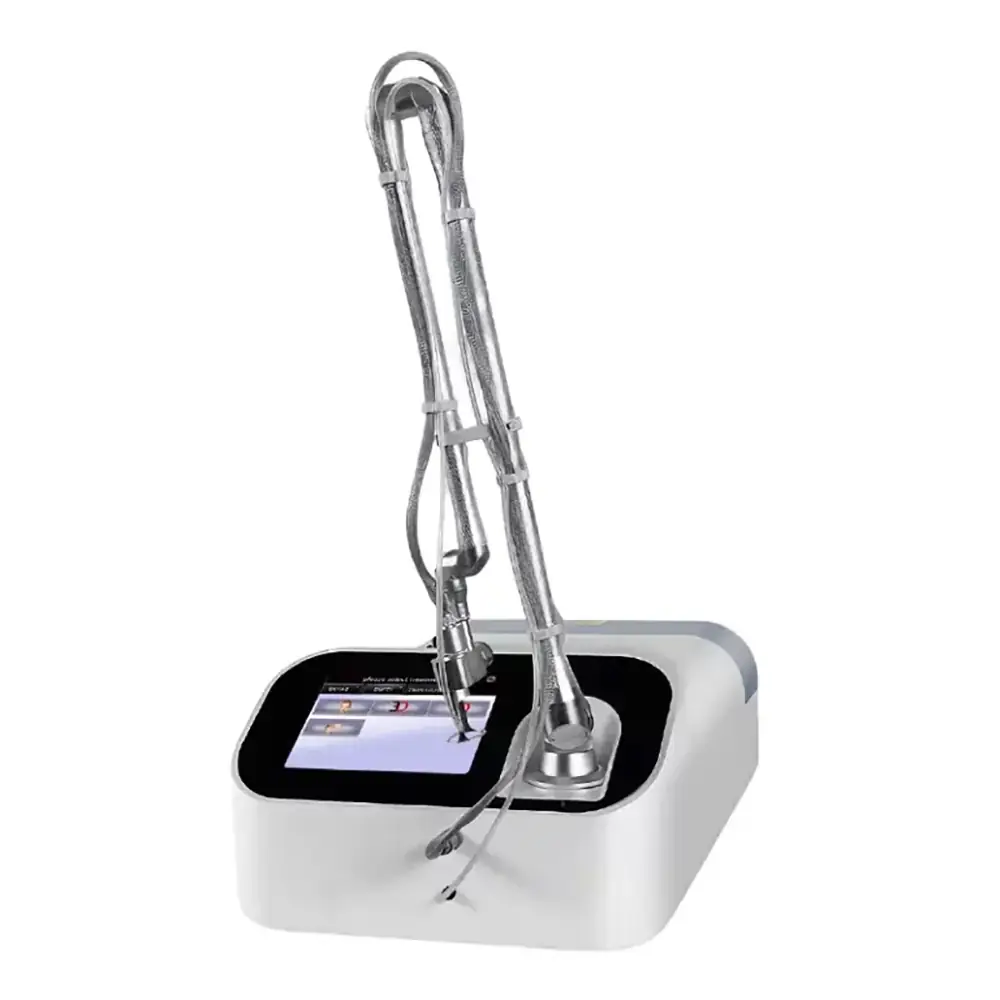
As this technology has evolved, its clinical application has also become more workflow-oriented. Portability, in particular, has expanded how and where these treatments can be delivered. Instead of relying on a fixed, dedicated laser suite, practitioners can reposition the device between treatment rooms, optimize scheduling efficiency, or support multi-site clinical operations using a single system.
In this context, a portable fractional CO2 laser is not defined only by mobility, but by the balance it achieves between compact design and full clinical capability — maintaining scanning precision, energy stability, and multi-handpiece versatility within a streamlined platform.
A CO2 laser resurfacing machine works in two connected stages: an immediate ablative effect that vaporizes targeted tissue, followed by a longer thermal remodeling response within the dermis. This second phase is what drives the laser’s longer-term rejuvenation effects. Controlled micro-injuries trigger immediate collagen contraction, producing visible tightening at the time of treatment, while beneath the surface a repair cascade begins: fibroblasts are stimulated to synthesize new collagen and elastin, a process that continues over the following weeks and months and results in progressive improvement in skin firmness and texture.
In clinical practice, physicians can select from multiple scanning patterns — including square, rectangle, triangle, hexagon, circle, and straight-line configurations — and adjust the pattern size to match the treatment area, up to a maximum scanning area of 20 mm × 20 mm. This flexibility allows energy delivery to be tailored to different skin conditions and treatment goals, while also helping minimize the risk of hypopigmentation.
This platform allows clinics to address two distinct clinical needs with a single system, enabling a clinic to expand its addressable patient base with one capital investment.
The fractional scanning head is used across a range of skin rejuvenation applications, including:
Acne scars: The laser penetrates into the dermis to break down fibrous scar tissue and stimulate collagen remodeling. New collagen gradually fills depressed areas, leveling the skin surface and reducing the appearance of pitted scars.
Deep wrinkles: Deep wrinkles around the eyes and mouth respond well to this treatment. Controlled micro-injuries cause immediate collagen contraction for instant tightening, while the healing process generates new collagen over months to restore elasticity.
Photoaging: Sun-damaged skin with rough texture, uneven tone, and lost elasticity is addressed simultaneously. The laser removes the damaged outer layer and rebuilds deep collagen, bringing smoother texture, even tone, and youthful resilience.
Pore refinement and laxity: Collagen loss causes laxity and enlarged pores. The laser delivers heat for immediate tissue contraction and triggers neocollagenesis; new collagen forms a tighter network that supports skin structure, refining pores and lifting facial contours.
Scar revision: Raised or depressed scars from surgery, trauma, or burns are significantly improved. The laser ablates excess tissue in hypertrophic scars or stimulates collagen filling in atrophic scars, softening texture, reducing redness, and blending scars into normal skin.
Using a 360° rotating probe, the same laser delivers CO2 energy uniformly to the vaginal wall, creating controlled microthermal zones in the mucosa and connective tissue, and triggering immediate collagen contraction along with a regenerative response:
Tightening: Countering stretching from childbirth and aging, the laser induces immediate collagen contraction for noticeable tightening within days. Continued collagen remodeling enhances firmness and elasticity over the following weeks.
Stress urinary incontinence: The laser strengthens the anterior vaginal wall and supportive tissues stabilizing the urethra, restoring collagen density to improve urethral support and reduce leakage during coughing, sneezing, or exercise.
Vaginal dryness and atrophy: By stimulating the epithelium to produce glycogen and mucopolysaccharides, the laser helps restore normal pH and lubrication. The thickened, rejuvenated lining resists irritation, reducing dryness, itching, and burning.
Sexual function: Improved tone, blood flow, and mucosal health enhance satisfaction. Restored elasticity and lubrication reduce discomfort, while increased vascularization heightens sensitivity and arousal.
Aesthetic rejuvenation: Applied to the vulvar area, the laser reduces hyperpigmentation and improves skin texture for a more youthful external appearance.
For clinics, offering both services under one roof means dermatology and cosmetic gynecology no longer require separate devices — a practical advantage as more women seek non-surgical options for intimate wellness.
During a single treatment session, the practitioner may choose from:
Fractional scanning head: Available with six scanning patterns — square, rectangle, triangle, hexagon, circle, and straight line — with a maximum scan area of 20 mm × 20 mm. Physicians can freely adjust the pattern size during treatment based on the target area, helping minimize the risk of hypopigmentation.
Cutting tip for lesion removal: Employing ultrapulse technology, the 10600 nm cutting handpiece vaporizes and carbonizes warts, moles, and similar lesions in microsecond-level high-energy pulses. Because heat diffusion time is too brief to cause significant collateral damage, surrounding healthy tissue is preserved, while thermal effects close surrounding microvessels for immediate hemostasis and a clear operating field.
Vaginal treatment probe: The 360° rotating probe delivers CO2 laser energy uniformly to the vaginal wall, creating controlled microthermal zones in the mucosa and connective tissue.
Interest in cosmetic gynecology has grown alongside continued demand for laser skin resurfacing for acne scars, wrinkles, and photoaging across age groups. For clinic owners, a dual-application platform means skin rejuvenation and intimate wellness services can be offered from a single system, avoiding the need for two separate capital purchases and creating cross-referral opportunities between the two patient populations.
For distributors and buyers, choosing a CO2 fractional laser equipment supplier has lasting operational consequences. A reliable partner should be able to provide clinical training, treatment protocols, and ongoing technical support to help clinics launch new services with confidence.
A: This system combines three handpieces on a single 10600nm CO₂ platform — a fractional scanning head for skin resurfacing, a cutting tip for lesion removal, and a 360° rotating probe for non-surgical vaginal tightening. Clinics can address both dermatology and cosmetic gynecology indications without purchasing separate equipment.
A: Documented applications include acne scars, deep wrinkles, photoaging, pore refinement and mild-to-moderate laxity, and scar revision for both hypertrophic and atrophic scars from surgery or trauma.
A: Six scanning patterns — square, rectangle, triangle, hexagon, circle, and straight line — with a maximum scan area of 20 mm × 20 mm. Physicians can adjust the pattern size during treatment to match the target area, which helps minimize the risk of hypopigmentation.
A: The laser beam is divided into thousands of microscopic treatment zones, each surrounded by intact, healthy tissue. Because the surrounding tissue is left untouched, healing is faster than with traditional fully ablative resurfacing, which treats the entire skin surface at once.
A: The cutting tip uses ultrapulse technology to vaporize warts, moles, and similar lesions in microsecond-level high-energy pulses. Because the heat diffusion time is too brief to spread, surrounding healthy tissue is preserved, and the thermal effect closes surrounding microvessels for immediate hemostasis and a clear operating field.
A: Lufenbeauty states a company-wide policy of a 3-year warranty on devices and a 6-month warranty on accessories, along with after-sales support for technical questions.
Aesthetics is no longer confined to separate dermatology and gynecology categories, as patients increasingly expect comprehensive, non-invasive solutions under one roof. For clinics, this shift directly impacts how treatment portfolios are designed, how equipment investments are prioritized, and how long-term profitability is achieved.
The portable fractional CO2 laser addresses this transition by integrating multiple clinically validated applications into a single 10600 nm platform. It enables providers to expand service offerings without increasing equipment complexity, making it a strategic option for clinics aiming to improve utilization efficiency and broaden patient reach.