What Is the Difference Between Fractional CO2 Laser and Traditional CO2 Laser?
Key Takeaways Why Is Fractional CO2 Laser Increasingly Used for Modern Skin Resurfacing? CO2 laser treatment is widely used for skin resurfacing because water strongly...

Modern beauty clinics, medical spas, skincare centers, and beauty brands increasingly use digital imaging to make skin consultations more objective. A digital skin analyzer can combine multi-angle imaging, different light modes, 3D facial imaging, AI analysis, and automated reports in one device.
For B2B buyers, however, a long specification list does not automatically indicate better performance. A high megapixel count, more light modes, or an “AI-powered” label only adds value when these features improve image quality, analysis, staff workflow, or customer communication. Buyers also need to consider software costs, data management, maintenance, and after-sales support. This guide explains what to evaluate before purchasing a 3D skin analysis machine for a clinic, beauty business, or skincare brand.
A 3D skin analysis machine combines facial imaging with software analysis to create a more complete record of the skin. Compared with a basic skin analysis camera, a 3D system can capture multiple facial angles and use different lighting conditions to reveal different skin characteristics.
| Comparison | Traditional 2D Skin Analysis | 3D Skin Analysis | |
| Imaging method | Captures flat, front-facing facial images | Captures multiple facial angles and reconstructs a 3D view | |
| Facial information | Mainly shows visible surface features | Provides more complete information about facial contours | |
| Comparison | Depends more on consistent viewing angles | Makes before-and-after comparisons easier to standardize | |
| Capture process | Usually requires a single viewing angle | Multi-angle capture can reduce the need for repeated positioning | |
| What Buyers Should Check | — | Camera arrangement, image reconstruction, and repeatable positioning |
For procurement teams, the key question is not simply whether a machine is labeled “3D.” Buyers should check how multiple angles are captured and combined, and whether the same positioning can be repeated during future consultations.
Different light modes reveal different skin characteristics, so buyers should focus on what each mode contributes rather than simply counting the number of light sources.
| Light Mode | What It Can Help Show | Practical Use |
| White light | Skin tone, pores, acne, wrinkles, and texture | Basic visual assessment |
| Polarized light | Reduces surface reflection and highlights skin features | Pigmentation, texture, and redness assessment |
| UV/Wood’s light | Fluorescence and pigmentation-related information | Additional assessment of pigmentation and other concerns |
| Red light | Certain vascular and inflammatory features | Supporting redness and inflammation analysis |
| Other specialized modes | Specific skin characteristics | Additional analysis views |
Capture conditions can affect image consistency. Ambient light, camera distance, facial position, lighting output, and device calibration may all influence the results.
This matters when tracking changes over time. If the lighting or facial position differs significantly between examinations, image changes may not accurately reflect changes in the skin.
Before purchasing, buyers should check for controlled lighting, consistent facial positioning, and a clear calibration process. Repeatable capture conditions are especially important for tracking treatment progress.
Instead of choosing the machine with the longest specification list, buyers should consider how each feature meets their actual business needs.
Camera Resolution and 3D Imaging
Higher resolution can capture more image detail, but megapixels alone do not determine image quality. Buyers should also consider the number of skin analysis cameras, image sensor, lens quality, image processing, 3D reconstruction, and capture consistency.
It is also important to confirm whether the stated resolution is native. A multi-camera setup can reduce repeated positioning and make daily consultations more efficient.
Look at What the AI Can Analyze, Not Just Whether It Uses AI
“AI-powered” is now a common product claim. Buyers should check what the AI actually analyzes, how many indicators it covers, whether it supports skin classification, and how it handles different skin tones.
They should also confirm whether the software can generate reports, compare results over time, and provide care or product recommendations. The value of AI lies in turning facial images into clear, useful results for both staff and customers.
Ease of Use Matters as Much as Technical Features
Advanced imaging features do not always mean a smoother workflow. Too many manual steps can increase training time and slow down consultations.
Buyers should review the full process, from customer positioning to the final report. Key points include capture time, head positioning, automated image capture and analysis, and report generation. Functions such as local skin measurements and skin or scalp analysis can also add value for businesses with broader service needs.
The purchase price is only one part of the total cost of owning a digital skin analysis machine. Software, data storage, maintenance, repairs, and technical support can all affect costs over several years.
Before purchasing, buyers should clarify the software license, update policy, and any monthly or annual fees. They should also check cloud storage costs, user or database limits, and available report formats such as PDF, CSV, or API.
For medical aesthetics businesses, data security also matters. Buyers should confirm how facial images and customer records are stored, accessed, backed up, and deleted. Relevant HIPAA or GDPR compliance documentation should be requested rather than assumed.
Installation requirements can also affect the real cost of ownership. Buyers should confirm the device footprint, required installation space, operating environment, cleaning procedures, calibration requirements, and availability of replacement parts.
Warranty terms, technical support, and repair turnaround time are equally important, especially for international B2B purchases. A lower equipment price may have less value if spare parts are difficult to obtain or technical support is slow. Installation, calibration, spare parts, warranty, and repair service should therefore be considered part of the initial purchasing decision rather than issues to address after the equipment arrives.
At Lufen Beauty, we developed the K33 AI Skin Analyzer to help beauty businesses provide faster and more detailed skin assessments. We combine multi-angle 3D imaging, eight-spectrum imaging, AI analysis, and automated reports in one device. This allows beauty consultants to collect more skin information during a single analysis and present the results more clearly.
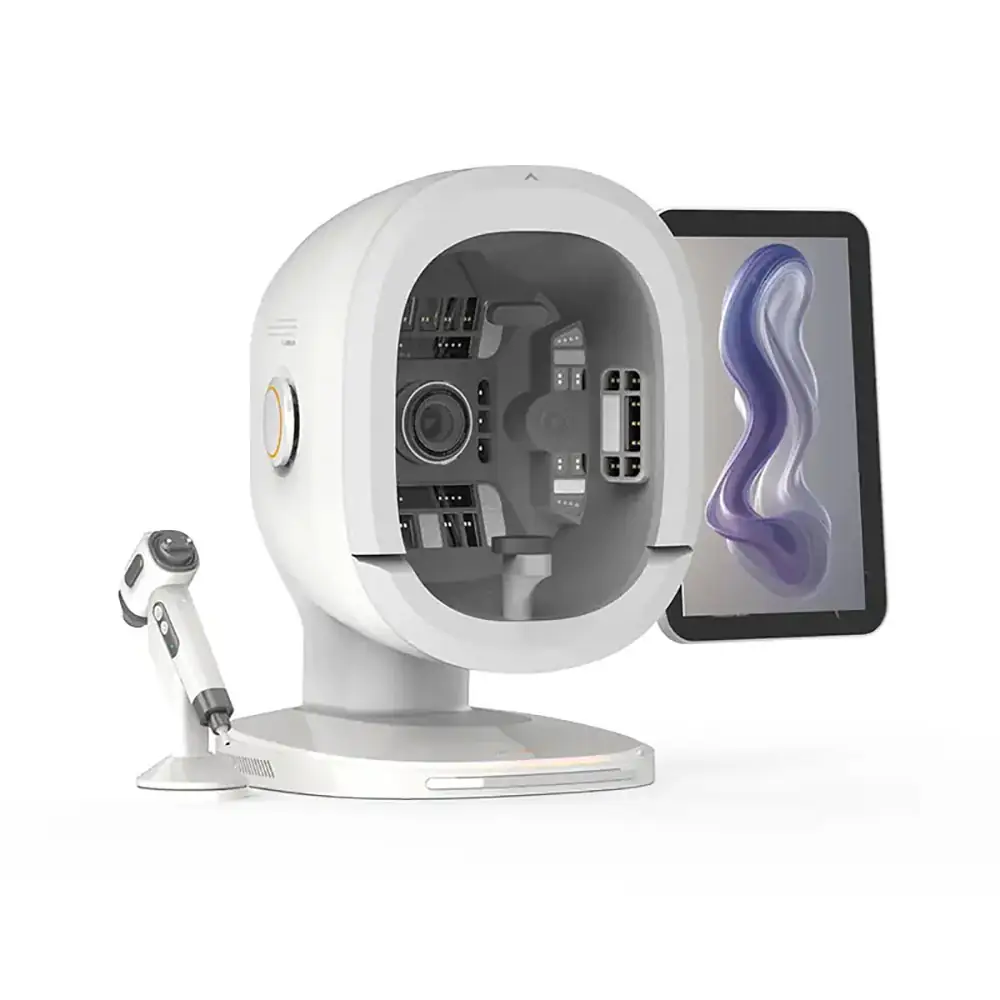
We equip the K33 with a 36MP triple-camera setup that captures the front, left, and right sides of the face simultaneously. The three-camera design provides 180° facial coverage and reduces the need for repeated head movement or repositioning. This helps shorten the analysis process while providing more complete facial images for comparison. Our 3D cross-sectional imaging function can also present layered skin information for a more detailed assessment.
We use eight light spectra to capture different skin characteristics that may not be clearly visible under standard lighting. The K33 analyzes concerns such as moisture, pores, sebum, acne, wrinkles, pigmentation, roughness, sensitivity, and other skin indicators. Different imaging modes help highlight surface conditions, pigmentation, redness, texture, and other visual features. This gives consultants more information to use during customer consultations.
We integrate AI analysis into the K33 to turn captured images into visual reports. Heatmaps, redness maps, measurements, and analysis results make it easier for consultants to explain specific skin concerns to customers. We also provide functions such as skin age assessment, skin type recognition, aging simulation, and local skin measurements. These features can help businesses track changes over time and make consultations more visual and easier to understand.
Before placing an order, use the following checklist to compare suppliers and models:
| Procurement Factor | Questions to Ask |
| Camera system | How many cameras are used? What is the native resolution? |
| 3D imaging | How are multiple views captured and reconstructed? |
| Light modes | Which spectra are available, and what does each mode show? |
| Analysis indicators | Which skin concerns and measurements are included? |
| AI and skin classification | What does the AI analyze? How are different skin tones supported? |
| Reports | Are reports generated automatically? Can they be customized or exported? |
| Software | Is the license perpetual or subscription-based? |
| Data | Where are images and customer records stored? Can data be exported? |
| Installation | What space, environmental conditions, and calibration are required? |
| Support | What warranty, spare parts, technical support, and repair service are provided? |
| B2B sourcing | What are the MOQ, lead time, customization options, and quotation terms? |
A: The K33 uses a 3-camera setup to capture the face from multiple angles in a single session, so customers do not need to manually rotate their heads. It automatically generates a 3D panoramic image within 1 second, improves detection efficiency by 60%, and helps avoid inaccurate comparison data caused by differences in head angles.
A: The 36MP high-resolution imaging combined with 8 professional light spectra can penetrate the epidermal and dermal layers to reveal hidden pigmentation, dilated capillaries, porphyrin and sebum, fluorescent residue, and signs of deeper skin aging and damage that are not clearly visible to the naked eye.
A: The K33 is designed for simple operation, allowing new users to get started quickly. It supports one-click flash capture, automatic Baumann 16 skin type classification, and one-click generation of professional reports with analysis and care-plan recommendations, helping lower the barriers to customer communication and upselling.
A: The K33 can shorten the complete skin analysis process to about 1 minute, helping businesses serve more customers each day. Its intuitive 3D aging trend prediction and comparison features can also support customer communication, while care-plan and product upselling conversion can increase by more than 35%, according to the supplied product information.
A: The K33 main unit comes with a 3-year warranty, while accessories such as the detection handle have a 90-day warranty, along with lifetime after-sales support. For routine maintenance, simply switch off and unplug the device before gently wiping the exterior with 75% alcohol, while keeping liquid away from the ports.
Choosing a 3D skin analysis machine is not simply about selecting the highest resolution or the largest number of AI functions. Buyers should consider how the system captures images, what information it provides, how easily staff can use it, and how much it will cost to operate over time. Data management, calibration, maintenance, warranty, and technical support also deserve attention before procurement. For skincare brands and distributors, sourcing requirements such as customization, MOQ, lead time, and supplier support should be evaluated alongside the equipment itself.
Looking for a 3D skin analysis machine for your clinic, beauty business, or skincare brand? Contact Lufen Beauty to request K33 specifications and a quotation.