Laser Hair Removal Machine ROI: Costs and Payback
Laser hair removal machine ROI, or return on investment, compares the startup outlay with cash earned after running costs. To estimate payback, divide that outlay...

A freckle or a sun spot is a small deposit of melanin that the skin has made itself. Tattoo ink is something else entirely. It is a foreign material, pushed through the epidermis and parked in the dermis, where the body cannot simply shed it. From the moment the needle stops, the immune system treats the deposit as debris to be contained rather than removed.
That containment is the reason tattoos last. Macrophages swallow individual pigment particles and hold them in place, and when those cells die, the particles are taken up again by the next generation. The ink never really leaves. It only changes hands.
Removal works by interrupting that cycle. A short, intense pulse of light is absorbed by the pigment, and the particle heats and expands faster than it can dissipate. The resulting mechanical stress fractures one large particle into many small ones.
Fragmentation matters because the body clears by surface area, not by weight. One particle of 5 micrometres presents little total surface to the enzymes and cells that would digest it. The same volume broken into hundreds of sub-micron fragments presents a great deal more. The smaller the debris, the faster the lymphatic route can carry it away.
Depth adds a second constraint. Tattoo pigment typically sits one to two millimetres below the surface, which is beyond the reach of the epidermis and well within the dermis. A wavelength has to travel through the epidermis to get there without dumping its energy in the melanin on the way in.
Nothing leaves the skin during the appointment. The treatment creates debris; the body removes it over the following weeks. That lag is why sessions are spaced six to eight weeks apart rather than scheduled back to back. Treating again too soon adds fresh trauma to tissue that is still clearing the last round, and it tells the operator very little about how well the previous session actually worked.
Absorption is a property of chemistry, not of effort. Every pigment absorbs some wavelengths strongly and others hardly at all, and a laser can only act on what the ink is willing to absorb. A picosecond tattoo removal machine changes how violently a particle breaks apart once the energy is inside it. It cannot change what the pigment absorbs in the first place.
| Ink colour | What the ink is built from | Wavelength that targets it | Realistic expectation |
| Black, dark grey | Carbon-based pigment | 1064 nm | Clears most readily; fewest sessions |
| Dark blue, deep purple | Organic dyes with metal salts | 1064 nm, with 755 nm where fitted | Good progress, usually partial per session |
| Red, orange, warm brown | Organic azo dyes, iron oxide in some inks | 532 nm | Responds well, though some reds darken before they fade |
| Green, teal, pale blue | Copper phthalocyanine | 755 nm closest; 532 and 1064 only reach the edges | Hardest group; often incomplete |
| Yellow, white, flesh tone | Titanium dioxide, zinc oxide | None of the common wavelengths absorb it well | Highest risk of turning grey; treat with caution |
| Cosmetic ink (brow, lip, liner) | Iron oxide with titanium dioxide | Mixed, pigment-dependent | Needs a test spot; response is hard to predict |
Four lines worth saying out loud in a consultation:
Carbon pigment is the most cooperative target in the whole category. It absorbs broadly across the near-infrared, so a 1064 picosecond laser reaches it through the dermis with comparatively little loss at the surface. Black outlines and grey shading are also usually the oldest part of a design and the most superficial, which helps.
Cool tones are where optimism usually outruns reality. Green and teal inks are built on copper phthalocyanine, a molecule that holds its colour stubbornly and absorbs poorly at 1064 nm. A 755 nm channel reaches this family more effectively where a platform carries one, yet even then clearance tends to be gradual and sometimes incomplete. Clinics that treat a lot of colour work should plan for more sessions here than anywhere else on the chart.
Warm pigments respond to 532 nm, which is absorbed readily by red and orange dyes. The complication is composition. Some red inks contain iron oxide, and iron oxide can oxidise to a darker state after the first session. The tattoo looks worse before it looks better, and a client who has not been warned will read that as damage.
Titanium dioxide, the base of most white and flesh-tone ink, absorbs very little at any wavelength used for removal. Worse, the energy it does absorb can drive a chemical change that leaves the treated area darker than the surrounding skin. This is the one group where the honest answer is often to leave it alone, or to treat a small test area and wait.
Two tattoos of the same size can need very different courses. Size is the least useful predictor a clinic has, and no faster picosecond laser tattoo removal machine will change that on its own. The variables worth discussing at the consultation are the ones below.
A dense, saturated block of colour holds far more pigment per square centimetre than a fine outline, so each session can only clear a fraction of the total. Cover-ups compound the problem, because an older design sits beneath the newer one and the two may not share the same chemistry. Fresh tattoos are worth a conversation of their own: pigment that has been in place for years has already been partly broken down by the immune system, while a tattoo finished last month still has most of its load intact.
Ink on the ankle, the ribs or the fingers sits in tissue with thinner dermis and poorer circulation, and it clears more slowly than the same ink on the forearm. Skin tone matters for a different reason. More epidermal melanin means more competition for the energy, so the operator has to work with lower fluence, longer intervals and more conservative settings. That trade protects the skin and costs sessions.
The gap between visits is part of the treatment, not a pause in it. Six to eight weeks gives the lymphatic route time to move the debris and gives the operator a clean look at the result. Clients who return early, or who skip sun protection in between, tend to need more sessions than the ink alone would suggest.
Any injury to the skin can leave pigment behind, and laser treatment is a controlled injury. On Fitzpatrick IV to VI skin the risk is higher, and it rises further with recent sun exposure, aggressive fluence or inadequate cooling. A test spot and a two-week review are not bureaucracy; they are how a clinic avoids treating the same patch twice for two different problems.
White and flesh-tone ink can darken immediately after treatment and stay that way. No wavelength in routine use absorbs titanium dioxide efficiently, so the energy tends to interact with what sits around the particle rather than the particle itself. Because the effect appears at once and is difficult to reverse, prevention is the whole strategy.
Blistering, prolonged crusting or a spreading area of redness all argue for a longer interval and a lower setting. So does a client whose tattoo has barely changed after three well-executed sessions. At that point the limiting factor is usually the ink’s chemistry, and further treatment adds risk without adding clearance.
Most clinics do not get to choose their patients’ tattoos, so the equipment has to cover the range that walks through the door.
Two wavelengths handle black and red, which is a large share of the market but not the difficult share. A third channel in the 755 nm region gives the operator a route into cooler colours that respond poorly at 1064 nm, and a fourth in the 1320 nm region opens pigment-adjacent treatments such as carbon-assisted cleansing.
Small spots concentrate energy and suit eyeliner, lettering and the edge of a design. Larger spots cover a filled area in fewer passes and reduce the total time the skin spends under the beam. A picosecond laser machine with a fixed spot forces the operator to choose between precision and throughput, and most clinics end up short of both.
Energy lost between the cavity and the skin is energy the client paid for and did not receive. An articulated arm holds alignment better than a long fibre run and keeps the beam profile even across the spot. On the skin side, contact or air cooling protects the epidermis while the pulse does its work. Just as important is the ability to see and adjust fluence, frequency and spot size during a session rather than between bookings.
This is the design logic behind the PC04 platform, a floor-standing unit built around a picosecond Nd:YAG laser with four output channels.
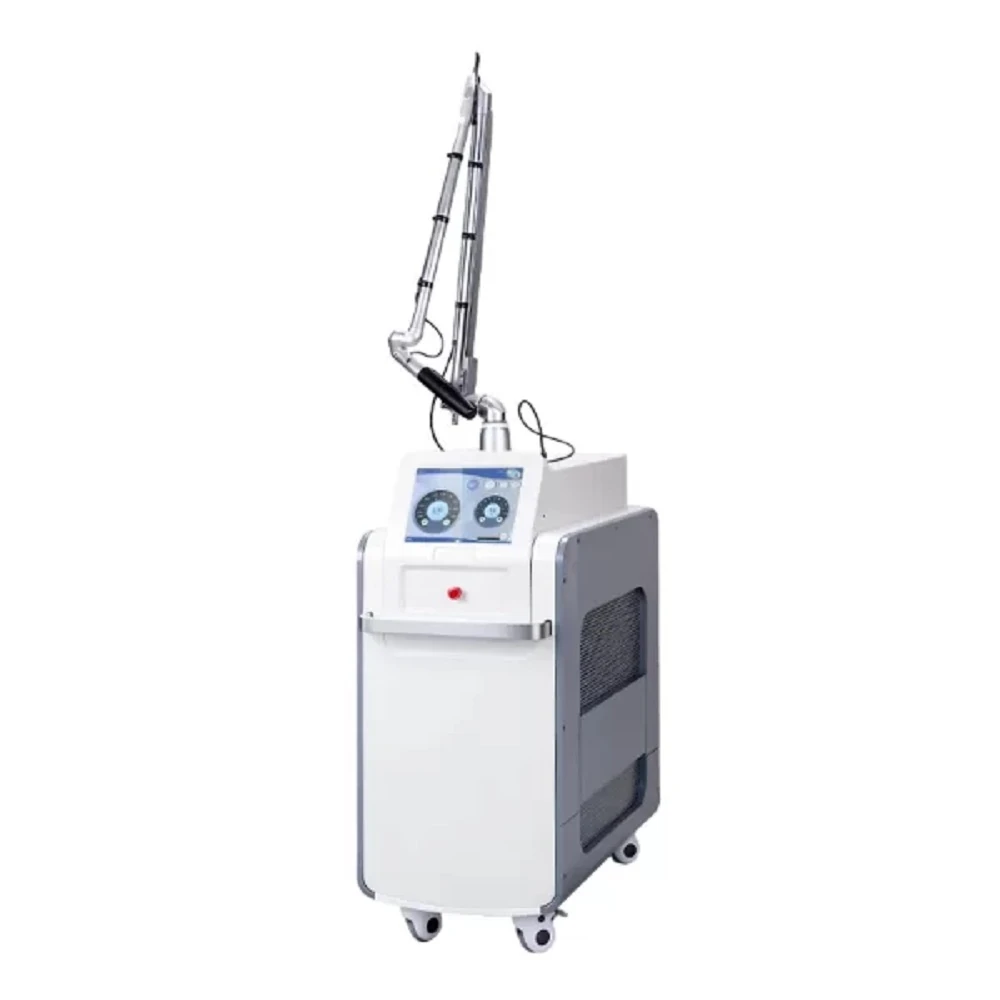
The 1064 nm channel takes black, deep blue and deep purple ink along with deeper dermal pigment. The 532 nm channel handles red, brown and orange. The 755 nm channel is aimed at brightening, evening out skin tone and lifting superficial pigment. It also sits closest to the absorption band of green and teal ink, which is where a cool-toned piece that will not shift at 1064 nm gets its best chance. The 1320 nm channel works with medical carbon powder for deep cleansing, oil control and blackhead care. For a clinic, that spread means one purchase covers tattoo removal, pigment work and a facial treatment rather than three separate machines competing for the same room.
Pulse duration is where picosecond platforms separate from the Q-switched generation. At 300 to 500 picoseconds, energy lands before heat has time to spread, so the dominant effect is mechanical rather than thermal. Ink breaks into finer debris, and the tissue around it absorbs less of the by-product. Clinics that previously ran eight to ten sessions on a nanosecond platform often report a course closer to four to six once the pulse shortens, though ink chemistry still sets the floor.
The delivery arm uses seven joints with total transmission loss held under five percent, and it rotates through a full circle without a dead angle. In practice that keeps peak power at the handpiece instead of losing it in the path, and it lets the operator reach awkward placements such as the inner ankle or the rib line without asking the client to twist.
A closed-loop water circuit carries temperature and flow sensors that cut the output if either drifts, and a sealed, dust-protected lens protects the optical path in a room where powder and aerosol are normal. A built-in 220 V / 10 A overcurrent protector absorbs supply fluctuations, which matters in markets where voltage is not stable.
For importers and clinic groups, the practical questions are rarely about the laser head alone. They concern spare-part availability, handpiece life, training, and whether the paperwork needed at the destination port can be produced on request. Regulatory and technical documentation can be supplied alongside a quotation, and OEM and ODM work is available for partners building their own brand.
No. It is better at fracturing pigment, because the pulse is shorter and the mechanical effect is stronger. That advantage is largest on dense, dark ink. On pale or white pigment, where absorption is poor at every wavelength, a shorter pulse does not solve the underlying problem.
White ink is usually titanium dioxide, which absorbs very little at the wavelengths used for removal. Energy that is not absorbed by the particle still affects the surrounding tissue, and the resulting chemical change can leave a grey or yellowish patch. Test spots are the only reliable way to judge the risk on a particular client.
An articulated arm carries the beam through mirrors rather than a flexible fibre, so less energy is lost on the way to the handpiece and the beam profile stays even across the spot. It also allows a full range of movement, which helps on curved and awkward body sites.
Most clients describe a sensation like a light elastic band snapping against the skin. Sensitive areas and large pieces are usually treated with topical anaesthetic and air cooling. A small design may take a few minutes, while a full sleeve is a longer appointment, and the honest answer always depends on the area and the density of the ink.
No, and no platform should be sold on that promise. Black and dark blue work clears most completely. Green, teal, yellow and white often leave a residue, and cosmetic ink behaves unpredictably. What a well-matched platform and an experienced operator can do is reach the best result that particular ink allows, in a realistic number of sessions.
Tattoo removal is a chemistry problem before it is an equipment problem. The ink decides which wavelength has any chance of reaching it, the depth decides how much energy is needed, and the body decides how fast the debris disappears. Once a clinic plans around those three facts, session estimates become honest and client conversations become much shorter.
Choose a platform that covers the colours your clients actually bring in, keep the spot size and fluence adjustable, and treat pale ink with the caution it deserves. If you are comparing picosecond platforms for a clinic or a distribution line, request the full technical sheet and a quotation configured for your market, and we will match the wavelength set and accessories to the tattoo work you see most often.