Laser Hair Removal Machine ROI: Costs and Payback
Laser hair removal machine ROI, or return on investment, compares the startup outlay with cash earned after running costs. To estimate payback, divide that outlay...

In today’s aesthetics and medical body contouring market, non-invasive technology is undergoing an unprecedented and rapid transformation. As consumer demand for non-surgical procedures with minimal downtime continues to surge, clinicians, medspa owners, and aesthetic practice managers are presented with an array of advanced device options. Among the various technological approaches, High-Intensity Electromagnetic Muscle Stimulation and 360° Cryolipolysis represent two distinct yet highly complementary engineering frameworks. The former concentrates primarily on muscle tissue activation, fiber hypertrophy, and structural toning, whereas the latter focuses specifically on targeted sub-zero adipose cell crystallization and natural metabolic removal.
For equipment purchasers, clinic operators, and prospective clients navigating cross-border trade platforms, blindly endorsing a single modality or dismissing alternative methods is neither a sound business strategy nor a scientifically grounded clinical practice. Each device architecture possesses unique structural advantages, physiological mechanisms, and inherent boundary conditions. This comprehensive guide provides an objective, multi-dimensional comparison covering physiological mechanisms, target tissue types, ideal patient profiles, clinical treatment protocols, return on investment (ROI), and safety considerations to help you make informed equipment acquisition decisions.
Understanding the fundamental distinction between electromagnetic muscle stimulation and cryolipolysis requires a deep dive into their underlying physical and physiological principles. EMS body sculpting equipment operates primarily on high-intensity electromagnetic field technology. As high-energy magnetic waves pass safely through the cutaneous and subcutaneous layers, they induce electrical currents within the motor neurons of deep skeletal muscle tissue. This stimulation vastly exceeds the physiological limits achievable through voluntary neuromuscular control, prompting intense supramaximal contractions. This process triggers structural myofibril remodeling, muscle fiber hypertrophy, and hyperplastic responses, while simultaneously generating a rapid surge in local metabolic demand that encourages cellular energy expenditure.
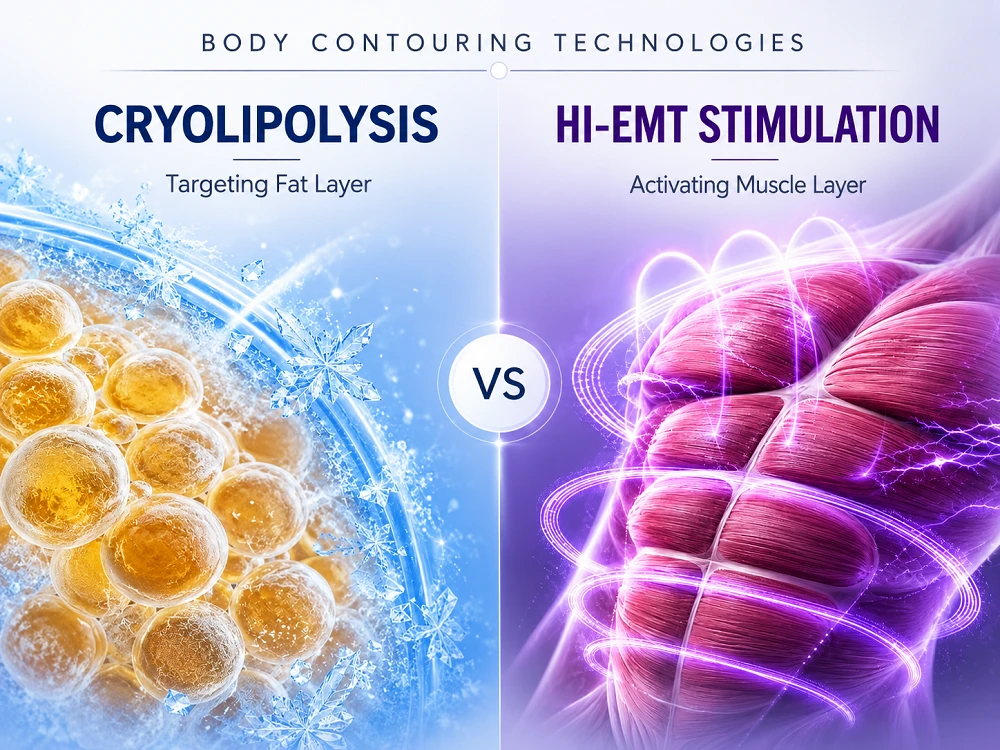
Conversely, cryolipolysis technology is founded upon the principle of selective cryo-lipolysis, leveraging the contrasting thermal sensitivities of different biological tissues. Subcutaneous adipocytes are particularly rich in saturated fatty acids, making them significantly more vulnerable to cold temperatures than adjacent water-rich dermal cells, capillary networks, and peripheral nerve fibers. Modern 360-degree surrounding cooling applicators utilize controlled vacuum pressure to deliver precise sub-zero thermal extraction (typically ranging from -4℃ to -10℃) to target tissue bulges, inducing apoptosis in vulnerable fat cells. Over the subsequent weeks and months, these apoptotic cell remnants are gradually ingested by macrophages and cleared via the lymphatic system, yielding a noticeable, permanent reduction in subcutaneous fat layer thickness.
Within human gross anatomy, skeletal muscle and subcutaneous adipose tissue form the dual architectural matrix governing outer body contours. The two devices address entirely distinct tissue layers. EMS body sculpting equipment specifically targets the deep skeletal muscle architecture. By enhancing baseline muscle tone, volume, and structural density, it refines visible body contours from the inside out. For instance, in the abdominal wall, it strengthens the rectus abdominis and oblique complexes, while in the gluteal region, it enhances the volume and firmness of the gluteus maximus and medius. Consequently, it acts primarily as an internal structural core sculptor and muscle conditioning platform.
On the other hand, cryolipolysis machine targets the subcutaneous fat layer positioned directly beneath the dermis and above the muscle fascia. Its primary objective is the systemic reduction of localized, pinchable adiposity, such as infraumbilical abdominal bulges, flank flanks, inner and outer thigh deposits, upper arm fullness, and submental fat. Importantly, cryolipolysis does not exert a direct mechanical effect on muscle tissue, nor does it alter muscle mass. Its primary aesthetic value lies in decreasing subcutaneous fold thickness and smoothing contours.
Recommending the optimal equipment modality requires a clear, objective analysis of the prospective client base, focusing on body mass index (BMI), skin laxity, tissue composition, and aesthetic goals.
In clinical practice, the two systems differ noticeably in operator workflow, client sensory sensation, session timing, and overall results expression.
A single session typically spans 30 minutes per target zone. During application, the patient experiences powerful, rhythmic muscular contractions interspersed with relaxing tapping phases designed to flush lactic acid buildup. The experience feels similar to an intense gym workout without joint strain. A standard clinical protocol comprises 4 to 8 sessions scheduled twice weekly. Visible improvements in muscle firmness and structural tone emerge within 2 to 4 weeks following treatment initiation.
A single application lasts between 35 to 60 minutes per applicator site. Initially, the patient experiences a firm vacuum tugging sensation combined with targeted cooling. Within 5 to 10 minutes, the local cutaneous thermal sensory receptors become desensitized, allowing the client to rest comfortably. Unlike ems body contouring therapy, cryolipolysis requires fewer sessions per area—typically 1 to 3 treatments, spaced 6 to 8 weeks apart to permit tissue clearance. Because fat elimination relies on macrophages and lymphatic transport, peak contour refinement manifests 6 to 12 weeks post-session.
For aesthetic clinic operators, medical spa owners, and regional equipment distributors, evaluating operational flexibility and projected return on investment (ROI) forms the bedrock of capital equipment procurement.
In modern non-invasive body contouring practices, the most progressive strategy does not involve choosing between electromagnetic stimulation and cryolipolysis. Instead, it leverages Combined Synergy Protocols. Adipose tissue and skeletal muscle form interconnected anatomical layers; addressing one without considering the other often yields incomplete aesthetic results.
For clients presenting with both substantial subcutaneous adipose bulk and poor muscle tone, a phased protocol yields superior outcomes. Commencing treatment with 360° Cryolipolysis successfully reduces the thickness of the overlying adipose blanket and diminishes prominent fat bulges. Once the subcutaneous layer has thinned—typically evaluated 4 to 6 weeks post-cryo—introducing Electromagnetic Muscle Stimulation sessions strengthens, lifts, and defines the underlying muscular baseline. This sequential “fat-reduction first, muscle-building second” protocol optimizes total aesthetic outcomes and enhances overall patient satisfaction.
In conclusion, neither electromagnetic muscle stimulation nor cryolipolysis can be deemed inherently superior to the other. Rather, each excels within its dedicated anatomical realm and serves specific clinical objectives.