RF Microneedling Cartridge Cost: A Clinic Buyer’s Guide
RF microneedling cartridge cost depends on the exact device and tip: compare the cartridge code, pack size, delivered price, and approved fit. Public seller prices...

Choosing the right laser hair removal technology is one of the most important investment decisions for any clinic owner. In practice, the challenge is not a lack of options, but the difficulty of interpreting similar-looking specifications across different systems.
Today’s professional market is mainly led by two solutions: multi-wavelength diode laser platforms, and systems combining alexandrite and Nd:YAG lasers. While both are widely used in clinical settings, they differ significantly in treatment logic, patient coverage, and operational workflow.
This guide compares how these technologies work in real clinical use, where each performs best, and how clinic owners can align equipment choices with their business model—beyond marketing claims.
A professional diode laser hair removal machine works on the principle of selective photothermolysis: laser energy targets melanin in the hair follicle, converts to heat, and destroys the follicle while leaving surrounding tissue intact. What distinguishes modern diode laser equipment is the integration of multiple wavelengths—755 nm, 808 nm, 940 nm, and 1064 nm—into a single platform. Each wavelength interacts differently with melanin, hemoglobin, and water, giving clinicians precise control over treatment depth, safety margin, and suitability for different skin and hair types.
Systems based on alexandrite and Nd:YAG lasers represent the traditional gold standard in laser hair removal. The alexandrite laser emits at 755 nm, which sits near the peak absorption of melanin, making it exceptionally effective for fine, light-colored hair on fair skin. The Nd:YAG component operates at 1064 nm, where melanin absorption drops significantly but penetration depth increases. This longer wavelength bypasses epidermal melanin more safely, allowing treatment of darker skin tones with a lower risk of burns or pigmentation changes.
What makes a long pulsed alexandrite laser especially relevant is its pulse width flexibility. By emitting energy in longer pulses (typically up to 100 ms), it can gently heat thicker follicles over time, reducing discomfort while maintaining efficacy. When paired with a 1064 nm Nd:YAG module in the same platform, the system becomes a versatile tool covering a wide Fitzpatrick skin type range.
The fundamental difference lies in how each wavelength interacts with chromophores. The 755 nm alexandrite beam is aggressively absorbed by melanin, giving it excellent clearance rates but also a narrower safety window for darker skin. The 808 nm diode sits in a balanced zone—still well-absorbed by melanin but with deeper penetration and slightly less epidermal risk. The 940 nm wavelength, often misunderstood, adds a unique angle: it has low melanin affinity, reducing epidermal heating, and is strongly absorbed by oxyhemoglobin. This coagulates the microvasculature feeding the follicle, helping to starve thick, deep follicles and adding a vascular targeting dimension that pure melanin-based lasers lack. The 1064 nm Nd:YAG wavelength prioritizes depth and safety for richly pigmented skin, sacrificing some melanin absorption for universality.
A four-wavelength diode system (755/808/940/1064 nm) is built for full-spectrum coverage. The 755 nm handles Fitzpatrick types I-II with precision; 808 nm smoothly covers types III-IV; 940 nm extends the safety and depth for types IV-V, particularly where vascular factors matter; and 1064 nm manages types V-VI with minimal epidermal risk. The result is a true all-in-one device where the operator can seamlessly match wavelength combinations to the patient’s profile.
An alexandrite plus Nd:YAG system offers dual coverage. The 755 nm arm excels on skin types I-III, delivering industry-leading speed and results on fair skin with dark hair. The 1064 nm arm then takes over for types IV-VI, trading some of the alexandrite’s fine-hair prowess for safe treatment on darker complexions. For clinic owners, this dual platform covers the vast majority of the population, but it does so with two distinct modalities rather than a graded, blended approach.
There is a clinical nuance here that matters to your bottom line. The 755 nm alexandrite wavelength is widely considered superior for fine, vellus-like hair precisely because of its high melanin absorption. If your clientele includes many patients seeking facial hair removal or treatment of light but visible body hair, long pulsed alexandrite laser performance is hard to beat.
Diode technology, particularly the 808 nm and 940 nm combination, tends to thrive on medium to thick hair. The 940 nm component’s absorption by oxyhemoglobin enables it to cut off the nutritional supply to deep, stubborn follicles—something beneficial for coarse hair on the bikini line, underarms, or male backs. The inclusion of 755 nm in a four-wave diode machine does bring fine-hair capability, but the alexandrite crystal still remains the benchmark for that specific task.
Modern diode machines with large spot sizes and high repetition rates are extremely fast on large body areas. When a professional diode laser hair removal machine offers adjustable spot sizes from small to large (e.g., 12×12 mm up to 15×20 mm or more), operators can treat a full back or legs in minutes. The “smart system” found in some models, which auto-generates parameters based on skin tone, area, and gender, further reduces procedure time by eliminating manual adjustments.
The alexandrite + Nd:YAG platform with spot sizes adjustable from 6 to 24 mm also delivers rapid coverage on big areas. The 755 nm alexandrite can operate with high fluency and larger spot sizes because of its efficient melanin absorption, which shortens treatment time on approved skin types. For a clinic with a high-volume alexandrite-eligible client base, this means quick sessions and high turnover.
Both technologies have matured to offer strong safety profiles when used correctly. Diode systems incorporate compressor-based refrigeration and internal water circulation that cool the sapphire contact tip, actively protecting the epidermis during the pulse. The 940 nm wavelength further reduces epidermal risk by minimizing melanin heating. With proper pre-ignition to stabilize energy output, the risk of hot spots or burns is mitigated.
The alexandrite system described uses an integrated Zimmer cooler that blows chilled air onto the treatment site before, during, and after the pulse. This non-contact cooling eliminates cross-infection risks and provides continuous thermal protection, which is particularly important when running high fluences necessary for tough hair. The ability to achieve high energy density without epidermal damage is a defining feature of a well-engineered 755/1064 nm platform.
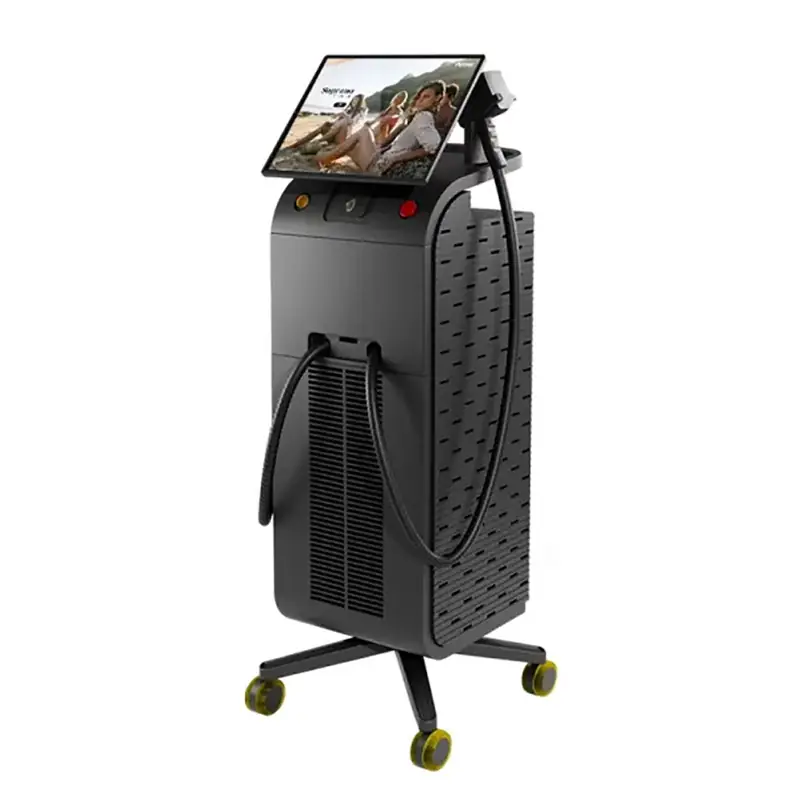
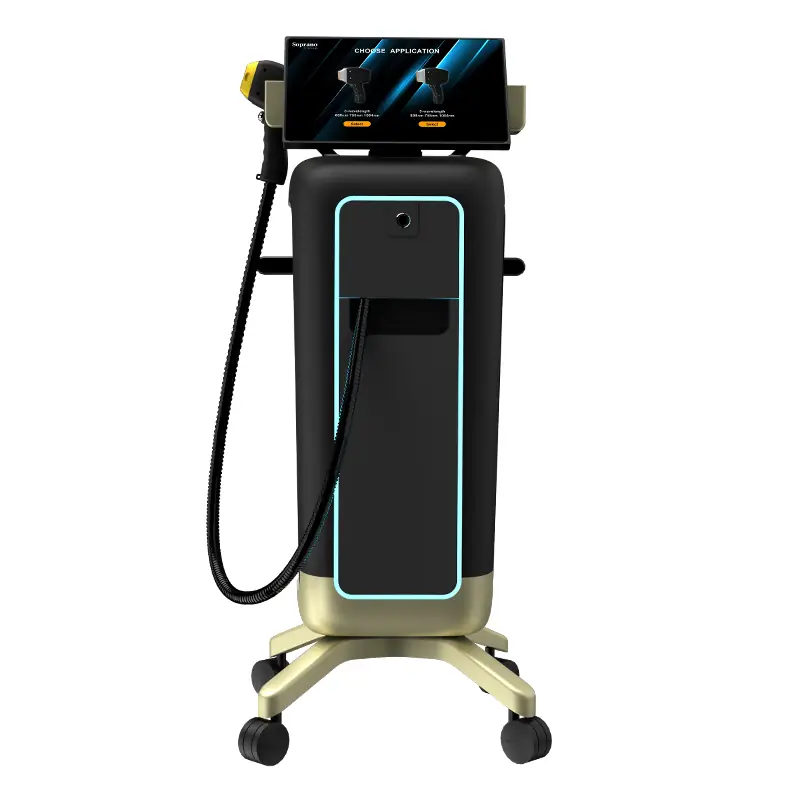
This diode laser equipment consolidates four clinically significant wavelengths into a single handpiece. The 755 nm component offers a solution for light skin and fine hair, while 808 nm covers the classic diode range for medium skin tones. The 940 nm component introduces a vascular targeting mechanism that coagulates microvessels supporting the follicle, accelerating atrophy of thick follicles. The 1064 nm allows safe, deep penetration for dark and tanned skin. Together, they allow a single machine to treat every skin type and hair texture encountered daily.
Its smart operating system reduces human error by generating treatment parameters after the operator inputs basic characteristics—skin tone, treatment area, gender. With five adjustable spot sizes and a compressor-based cooling system backed by an Italian water pump and American coherent laser bars, the architecture is designed for all-day stability and consistent output. The cooling performance supports high-power, high-frequency use without thermal shutdown, which directly impacts the number of patients a clinic can see per day.
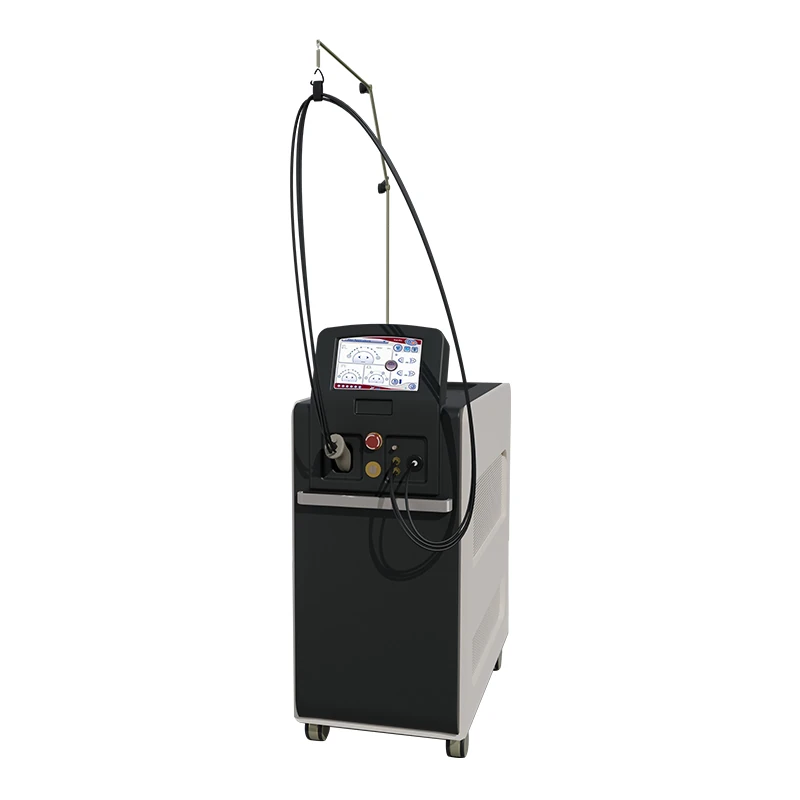
This dual-wavelength platform combines a long pulsed alexandrite laser at 755 nm with a 1064 nm Nd:YAG laser. Its pulse width, adjustable from 10 to 100 ms, allows customized thermal delivery to follicles of different sizes and depths. The alexandrite arm is the gold standard for fair-skinned patients with light or fine hair, and the Nd:YAG arm provides the safety margin required for dark skin and coarse hair.
The integrated air cooling system (Zimmer-type) sprays cold air directly from the handpiece, giving continuous epidermal protection without consumable gels or contact tips. This reduces consumable costs and contact-related contamination. Inside, the system is built with a UK-made xenon lamp and laser rod, imported fiber optic cable from the USA, twin high-power power supplies, and large capacitors to ensure uniform energy delivery pulse after pulse. The adjustable spot size (6–24 mm) makes it versatile for both delicate facial areas and large body surfaces.
The diode platform relies on semiconductor diode stacks and a compressor-driven water cooling circuit. The light is delivered through a contact-cooled sapphire window, and multiple wavelengths are emitted sequentially or simultaneously depending on the mode. The alexandrite/Nd:YAG system uses a solid-state crystal laser pumped by a xenon lamp, with air cooling applied externally. The two approaches lead to different maintenance profiles, consumable needs, and handpiece ergonomics.
A four-wave diode machine covers all Fitzpatrick skin types and most hair types from one device. This simplifies staff training and reduces the need for multiple platforms. The alexandrite + Nd:YAG combination covers skin types I–VI effectively but may require the operator to switch between the two wavelengths deliberately and perhaps accept a slightly lower margin for fine hair on dark skin, where Nd:YAG can work but is less efficient than in lighter phototypes.
Diode systems with smart parameter selection and large spot sizes can dramatically reduce treatment time per client, allowing more appointments per day. Since one machine can handle any patient walking through the door, scheduling becomes straightforward. The compressor cooling allows continuous use without downtime. On the other hand, the alexandrite + Nd:YAG system offers a “two machines in one” value proposition, often at a price point that is attractive when you need genuine alexandrite performance and broad Nd:YAG coverage without investing in two separate units. Its long pulse mode and efficient 755 nm absorption can translate into fewer sessions needed for the right patient group, which can be a strong marketing message.
Both solutions prioritize patient comfort with advanced cooling. The diode system’s contact cooling and lower peak absorption at certain wavelengths create a less painful experience for many patients. The alexandrite’s air cooling provides a non-contact, hygienic alternative that some patients prefer, especially when treating sensitive areas where contact might be uncomfortable. Side-effect risks are well managed by both when protocols are followed, but the inherent melanin-sparing property of the 940 nm diode and the 1064 nm Nd:YAG give each system a reliable path for darker skin.
An increasing number of successful clinics don’t choose just one. They install a dedicated professional diode laser hair removal machine as a workhorse for all skin types and high-volume days, while maintaining an alexandrite/Nd:YAG platform for fine-hair cases and specific patient requests. This hybrid approach maximizes clinical outcomes across the entire demographic and gives the clinic a competitive marketing edge as a technology leader.
A: Yes, a modern multi-wavelength diode platform that includes 755 nm, 808 nm, 940 nm, and 1064 nm can safely treat the full Fitzpatrick scale. The 1064 nm component handles deeply pigmented skin, while 940 nm adds safety by targeting the blood supply rather than melanin alone. Always use a system with robust cooling and spot size control.
A: A long pulsed alexandrite laser delivers energy over a longer duration, which allows heat to build up gradually in the follicle without spiking in the epidermis. This makes treatments more comfortable and safer, especially for thicker hairs on lighter skin, while maintaining the high melanin absorption that alexandrite is known for. It remains the gold standard for fair-skinned patients with fine or light-colored hair.
A: Many high-performing clinics eventually adopt both. A diode system can serve as the universal, high-efficiency daily driver, while the alexandrite/Nd:YAG platform covers premium alexandrite cases and provides a differentiated offering. If budget or space is limited, a four-wavelength diode machine can effectively treat almost every client; adding an alexandrite system later can elevate clinical versatility and marketing appeal.
Both diode and alexandrite-Nd:YAG technologies have evolved to meet real-world clinical demands. A four-wavelength diode machine brings universality, efficiency, and intelligent workflow, while a dual alexandrite and Nd:YAG system delivers the precision and pedigree of crystal-based lasers with powerful long-pulse capability. The right choice depends on your patient demographics, your team’s expertise, and your business model. What matters most is investing in genuine technology with proven cooling, quality components, and reliable after-sales support—because uptime, safety, and results are what ultimately build your clinic’s reputation.