RF Microneedling Cartridge Cost: A Clinic Buyer’s Guide
RF microneedling cartridge cost depends on the exact device and tip: compare the cartridge code, pack size, delivered price, and approved fit. Public seller prices...

Professional AI skin analyzers are capable of precisely identifying skin concerns even before they become visible to the naked eye. For beauty clinics and medical aesthetic centers, this means you can offer superior consultations, formulate more precise treatment recommendations, and demonstrate quantifiable results.
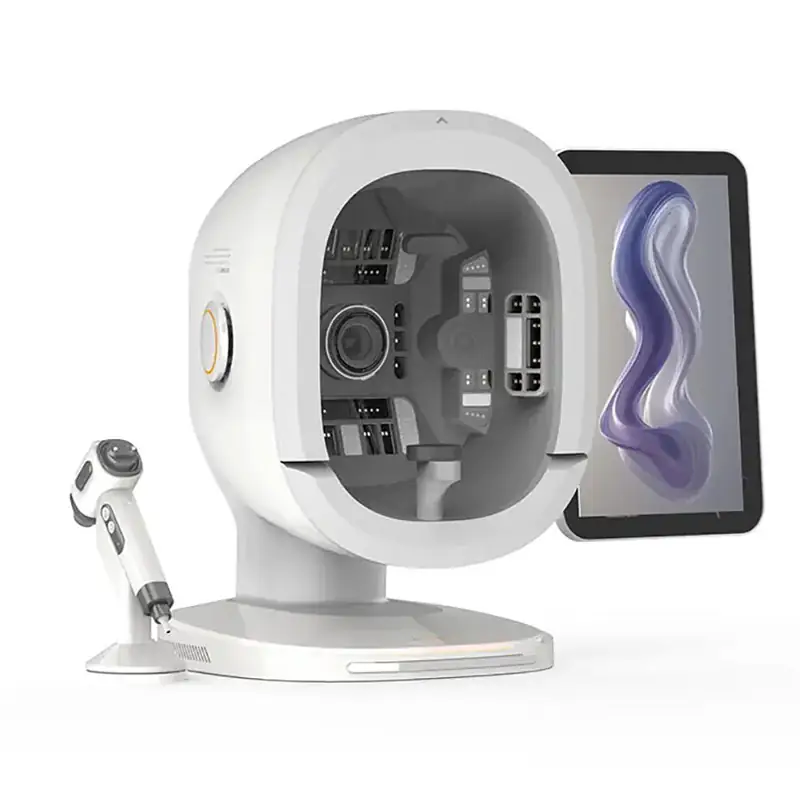
This guide will explain how AI skin analyzers work. The content covers dual-mode scanning, 8-spectrum imaging technology, 15 key indicators evaluated, and provides a comparative analysis against traditional skin detection methods.

An AI skin analyzer measures wrinkles, pores, pigmentation, and acne activity. It does this by comparing your skin to millions of images it has learned from.
This device features dual-mode functionality. Mode 1 is full-face scanning, which targets the T-zone, cheeks, and O-zone. It captures front, left, and right profiles so that it can build a 3D model and generate a report within 30 seconds. Mode 2 is handheld microscopic detection. While the main unit gives an overview of the face, the handheld probe focuses on specific concerns like deep-seated pigmentation, clogged pores on the nose, or fine lines around the eyes.
This system is capable of detecting 15 specific skin conditions. The table below summarizes these indicators:
| Level | Skin Indicators |
| Surface Level | Hydration, Sebum Level, Pore Status, Blackheads, Whiteheads, Superficial Pigmentation |
| Deep Level | UV-Induced Pigmentation, Wrinkle Sensitivity, Inflammation, Acne, Skin Texture Roughness, Collagen Loss |
Imaging technology is the core of professional AI skin analyzers. Our AI skin analyzer employs eight spectral technologies to reveal what’s beneath the skin’s surface, providing a 360-degree comprehensive diagnostic perspective. Its diagnostic capabilities far surpass those of devices with only two or three spectral technologies. The table below details each spectral mode and its main detection focus:
| Spectral Mode | Key Detection Focus |
| RGB White Light | Surface topography: wrinkles, pore size, active acne |
| Parallel-Polarized Light (PPL) | Skin texture clarity, fine lines, surface evenness (filters glare) |
| Cross-Polarized Light (XPL) | Subsurface redness, inflammation, superficial capillaries |
| UV Light | Bacterial porphyrins (acne-causing agents), deep pigmentation |
| Wood’s Lamp | Deep dermal melanin distribution, fungal or bacterial fluorescence |
| Brown Light | UV damage density, photoaging severity |
| Red Light | Hemoglobin concentration, revealing sensitivity and subcutaneous inflammation |
| Mixed Light | Comprehensive skin roughness and overall assessment |
True AI Deep Learning Algorithms vs. Traditional Image Recognition: Traditional skin analyzers typically rely on basic image recognition technologies, the adaptive and learning capabilities which have limited learning and adaptation capabilities, AI skin analyzers employ deep learning algorithms; thanks to continuous learning from large skin image datasets, their algorithmic performance constantly improves over time. This ensures that the device’s diagnostic capabilities become more refined and accurate with every use.
8-Spectrum Imaging Technology vs. 2–3 Light Sources: AI-powered smart devices utilize 8-spectrum imaging technology—encompassing RGB white light, positive and negative polarized light, Wood’s light, UV light, red light, brown light, and mixed light—to detect 14 to 15 distinct skin parameters, including deep pigmentation, UV damage, and collagen loss. Traditional devices, on the other hand, primarily employ just three light sources (standard light, UV light, and cross-polarized light), resulting in limited analytical dimensions. This multi-spectral technology enables AI devices to detect skin changes 3 to 8 weeks in advance, whereas traditional methods can only identify issues 1 to 2 weeks after they have become visibly apparent.
95%+ Consistency and Quantitative Tracking vs. Subjective Judgment: AI skin analyzers have a detection accuracy exceeding 95% and a result variability rate of less than 5%; by analyzing over 50,000 data points per scan, they provide objective and quantifiable skin metrics. In contrast, traditional manual analysis or lower-end products exhibit a variability rate of 15–20%, and—being susceptible to factors such as operator experience, fatigue, and ambient lighting conditions—give subjective results. Furthermore, AI devices feature dynamic aging prediction and long-term data tracking capabilities, allowing them to simulate how the skin’s condition may evolve over the next 5 to 10 years—a trend analysis and predictive functionality that traditional devices notably lack.
The adoption of this technology is widespread, with three core industries leading the market:
In dermatology clinics, plastic surgery hospitals, and general healthcare settings, the device serves as a medical-grade diagnostic aid. It provides objective, imaging-based data to assist in diagnosing conditions like melanoma, psoriasis, and severe acne, supporting treatment planning and measuring outcomes.
This is the fastest-growing segment. High-end salons and med-spas use the machine as a cornerstone for personalized service and client education. The visual, data-rich skin report transforms abstract concerns into understandable metrics, building trust and effectively guiding clients toward appropriate treatment packages, from hydrating facials to laser therapies.
Major beauty brands utilize these devices for in-store consumer consultations, creating an engaging “scientific” experience that boosts product conversion. In R&D labs, the professional skin analysis machine .
Although this product is relatively accurate, it cannot replace a professional doctor. High-end equipment has an accuracy rate of over 95% and an error rate of only about 5%, making it more stable and reliable than manual inspection (which has an error rate of 15% to 20%). It is suitable for routine monitoring, but you should still seek professional medical advice if any abnormalities are detected.
Common metrics include: acne, fine lines, dark circles, pigmentation spots, skin texture, skin age, elasticity, pH levels, and more. Professional-grade devices can also detect inflammation, pore conditions, hair/follicle health, and signs of aging.
Yes. The new system is designed to be compatible with a wide range of skin tones, although its accuracy may vary slightly depending on the specific skin tone, and the manufacturer is currently working to optimize this performance.
If you require high precision, you can choose professional-grade equipment; such equipment usually has functions such as 30x magnification and multispectral imaging.
Results can be influenced by environmental factors, lighting conditions, and the presence of makeup. For the most accurate readings, it is recommended to perform the test on clean, bare skin.
Based on data regarding moisture levels, pigmentation, and pore conditions, you can identify the most suitable skincare products and treatment regimens—then periodically re-evaluate and adjust your routine as needed.
It utilizes a combination of RGB+UV imaging, sensors, and AI algorithms. The core technologies involve UV imaging to visualize deeper skin issues, sensors to measure moisture, oil levels, and elasticity, and AI to analyze the captured image data.
The advent of AI skin analyzers marks a significant milestone in the skincare industry, offering high precision, versatility, and convenience. Whether you’re a medical professional seeking accurate diagnostic tools or a beautician looking to enhance client experiences, these devices represent a worthwhile investment.With their ability to provide objective, data-driven insights, AI skin analyzers are poised to redefine the standards of skin health management, ushering in a new era of personalized and effective skincare solutions.